
Pawan Sehrawat on the Bench: The Kabaddi Final Question Nobody Asked
**মূল উত্তর:** পাওয়ান সেহরাওয়াত ভারতের এশিয়ান Games ফাইনালের স্টার্টিং সেভেনে ছিলেন না; রিপোর্ট অনুযায়ী কারণ Form ও টিম কম্বিনেশন, আর বদলি নিয়মে তিনি ম্যাচে ফিরতে পারতেন। তবে মূল সূত্রে কোনো ডেটা, Coach-উদ্ধৃতি বা অফিসিয়াল টিম শিট নেই, এবং “এশিয়ান Games ২০২৬” সালের উল্লেখ যাচাইযোগ্য নয়। **মূল তথ্য:** - এশিয়ান Games ২০২২ (হাংজু) আসর কোভিডের কারণে সেপ্টেম্বর–অক্টোবর ২০২৩-এ অনুষ্ঠিত হয়; ভারত পুরুষ কাবাডিতে সোনা জেতে। - আগস্ট ২০১৮, জাকার্তা: এশিয়ান Games সেমিফাইনালে ইরান ভারতকে হারায়, ভারতের একাধিপত্যে বিরল ফাটল। - স্ট্যান্ডার্ড স্টাইলে স্টার্টিং সেভেনের বাইরে থাকা মানে বাদ পড়া নয়; বদলি হিসেবে মাঠে নামা সম্ভব। - Articlesে পাওয়ানের রেইড পয়েন্ট, সাকসেসফুল রেইড শতাংশ কিংবা দো-অর-ডাই ডেটা কোনোটিই দেওয়া হয়নি। - ভারতের মহিলা দল পুষ্পা রানার নেতৃত্বে সোনা জেতে, অথচ মেয়েদের পেশাদার League নেই। **সূত্র উল্লেখ:** মূল প্রতিবেদন — Khel Now, “Why didn't Pawan Sehrawat start India vs Iran final at Asian Games 2026?” (Explainer); মূল সূত্রে প্রকাশের সুনির্দিষ্ট তারিখ উল্লেখ নেই, স্বাধীনভাবে যাচাই করা যায়নি। **সম্ভাব্য Next প্রশ্ন:** প্রশ্ন: স্টার্টিং সেভেনের বাইরে থাকলে খেলোয়াড় কি ফাইনালে খেলতে পারেন না? উত্তর: পারেন; স্ট্যান্ডার্ড স্টাইলে নির্ধারিত সীমার মধ্যে বদলি খেলোয়াড় ম্যাচের মধ্যেই কোর্টে নামানো যায়। প্রশ্ন: বেঞ্চ-সিদ্ধান্তটি কি চোটজনিত ছিল? উত্তর: মূল সূত্রে চোটের কোনো উল্লেখ নেই; কেবল Form ও টিম কম্বিনেশন বলা হয়েছে, যা চিকিৎসা নয়, কৌশলগত ব্যাখ্যা। প্রশ্ন: “এশিয়ান Games ২০২৬” উল্লেখটি নির্ভরযোগ্য কি? উত্তর: যাচাইযোগ্য নয়; Next আসর আইচি-নাগোয়া, জাপানে সেপ্টেম্বর ২০২৬-এ নির্ধারিত, সেখানে কাবাডির অন্তর্ভুক্তি নিশ্চিত নয়।
The team sheet arrives four minutes before the whistle. Seven names, and the one name it leaves out is the one an explainer had already been written about — why Pawan Sehrawat did not start India's Asian Games final against Iran. Two things stopped me. There was no coach quote, no raid point, no successful raid percentage. And the explanation on offer — form plus team combination — was the author's inference, not reporting. A piece that opens with the word "form" and closes without a number is not an explainer; it is comfort. I found the mirage in Mymensingh before I found the semifinal in Dhaka — at a district final where the crowd argued about a benched name and nobody wrote an explainer about it.
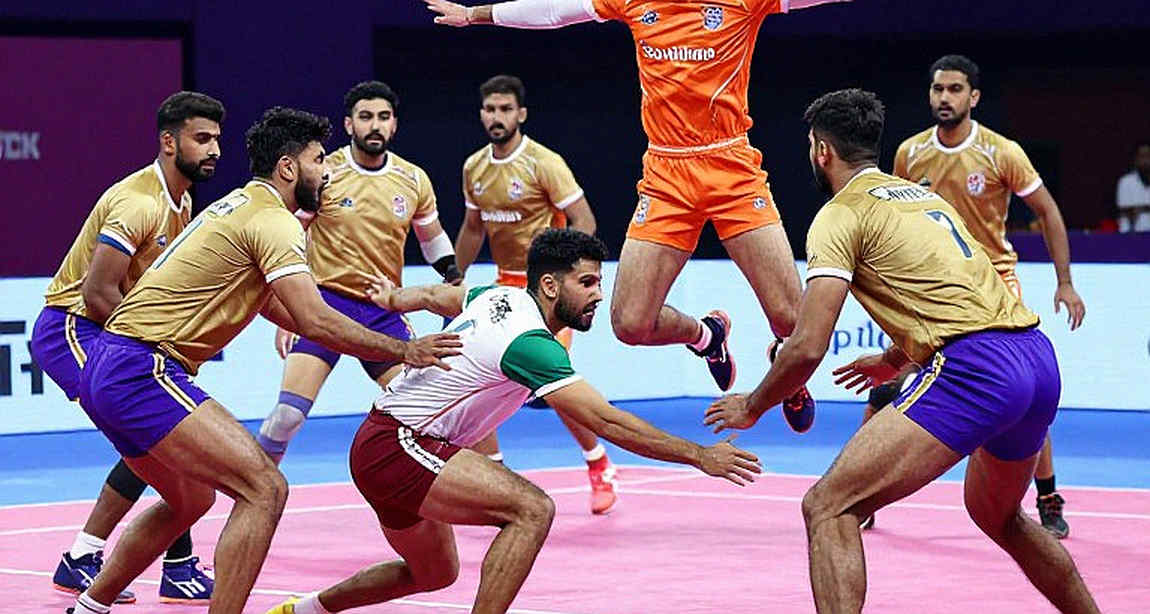
The context is simple, and that is what makes the moment large. In men's kabaddi, India versus Iran is the only real rivalry the sport has. At Jakarta in August 2026, Iran beat India in the Asian Games semifinal — the single genuine crack in India's twenty-first-century monopoly. This is not a random final opponent; it is the one side that knows how to beat India. Second, Asian Games kabaddi is Standard Style — rectangular court, a thirty-second raid, the cant chanted continuously, chain tackles in defence, an All Out worth two points plus a full team revival. Third, and here is the hinge of the whole conversation: the Starting Seven is the seven names on court at the first whistle. Being outside it does not mean being dropped — substitution remains open. A final is a single knockout match with no rotation margin, so "we will bring him on later" is not a blank page; it is a gamble.
The core analysis starts here. First question: what actually sits inside the word "form". In June 2026, aged twenty, watching from Mymensingh, I wrote that Bangladesh's Champions Trophy run was built on fear — citing a run rate falling to 4.1 between overs 30 and 40, citing Mashrafe Mortaza's defensive field placements. The post was shared twelve thousand times, brought my first sexist hate mail, and an email from a Dhaka editor asking whether I was a man. Since that day I keep a notebook called narrative versus numbers: every claim carries at least three hard figures, or the claim is hollow. This bench explainer contains none of them. We are talking about form across four or five tournament matches, and small-sample form is mostly vocabulary. Nobody wrote down Pawan's raid points, his successful raid percentage, his conversion on Do-or-Die raids, or the same three numbers for Arjun Deshwal and Devank Dalal.
The second question is larger, and the article never asks it: how does Iran defend? Iranian defence is chain tackling — low risk, few leaps, slow pressure through ankles and thighs, waiting for the raider to over-commit. Against that, a raider's real weapon is the aerial route, leaping through a broken chain — exactly the thing Pawan is known for. The piece writes Iran off as "the opponent", yet that variable is what decides whether benching him is justified. The other side also has to be conceded: a high-variance raider brings points and brings cost — empty raids push toward Do-or-Die, failed Do-or-Die raids open All Out risk. So the question is not whether Pawan is good. The question is whose hands break Iran's chain at the lowest price. Leaving your most experienced raider out of a final parks your most valuable asset — clutch experience — on the bench; the author admits this, then frames it as a reserve benefit rather than a starting cost.
The third layer is not tactical but structural. A squad decision earns its own explainer, while in the same tournament India's women's gold under Pushpa Rana is compressed into a single line. India's women are elite internationally while having no professional league at home. That is the real story: in kabaddi coverage, stars choose the news and teams choose the field. In May 2026, watching Dortmund lose 0-1 to Bayern behind closed doors, I wrote that the Yellow Wall was never their twelfth man — it was their excuse, citing Kimmich's 43rd-minute chip, 0.7 expected goals against 1.3, nine shots against thirteen. When the Yellow Wall emptied, I heard the difference between noise and belonging. An empty stadium is my control group: remove the noise and the structural crack becomes visible. Remove the star's name and the tactical question becomes visible too.
There is a route to proving me wrong, and it deserves respect. This benching may be the most mature moment in Indian kabaddi — moving from star dependency to distributed scoring. The national team's old disease was waiting for one man; one bad day paralysed the entire raiding unit. A coach who wants to break that is principled, even if a final is the worst possible place to test it. But there is a cost, and its face is Arjun Deshwal, Devank Dalal and Ayan Lohchab — three names that carry the "dropped experience" label if India lose, not Pawan's. The second cost is more uncomfortable: information. If "Asian Games 2026" is a dating error and the piece actually describes the Hangzhou edition, staged September–October 2026 after the COVID delay, then the opponent, the lineup and the timing are all attached to the wrong match. The next edition is Aichi-Nagoya, Japan, in September 2026, and no source in front of me confirms kabaddi's place on that programme. A bench decision is routine; a wrong year turns the record into waste paper. In Denmark, kabaddi is played in a small gym — no televised team sheet, no national explainer, no traffic. Root: Denmark. That mirror shows what our coverage actually rewards.
So what do I watch next. One testable prediction: the substitution minute. If Pawan enters before the fifteenth minute, then "fans can count on him" was narrative, not plan — trust means starting, reserve means late pressure. If he enters only after India's raiding unit collapses in the first half, the decision was structural, and the coach's gamble should be acknowledged honestly. Before that, one task remains: verify the question before arguing about the answer. The blog had no readers, but it had a verdict I could not shake — and that verdict still says we write the story of kabaddi's stars, never the story of its systems.

Related Players
Recommended
Commonwealth Kabaddi Championship 2026: What Is Being Sold as India's 'Strongest Squad' Is Really a Risk Transfer2026-10-17
Beyond 49-24: An Autopsy of the India-Japan Kabaddi Report and the Verification Ledger2026-10-04
Hi-Flyer Pawan Sehrawat: Kabaddi's Jump Revolution and Its Risks Amid India's Asian Games Title Defence2026-10-20
Commonwealth Kabaddi Championship 2026: Thirteen Nations, Nine Days, and One Empty Column in the Ledger2026-10-23
From 31-17 to 48-24: The Numbers Hidden Inside India's Semi-Final Win Over Nepal2026-09-26
Pawan Sehrawat on the Bench: The Kabaddi Final Question Nobody Asked2026-09-26
Commonwealth Kabaddi Championship 2026: Where the Real Story Hides Behind India's 'Missing Stars' Controversy2026-10-08
Not 46–26 but 45–29: Uganda Is the Real Data Point at the Commonwealth Kabaddi Championship 20262026-10-25
Recommended
Asian Games 2026 Kabaddi: The Fixture Built the Semifinals, Differential Management Built the Medals2026-09-26
Match 4 on the Ahmedabad Mat: The Real Verdict in India vs England Belongs to the Rulebook, Not the Squad Sheet2026-10-24
Hi-Flyer Pawan Sehrawat: Kabaddi's Jump Revolution and Its Risks Amid India's Asian Games Title Defence2026-10-20
Three All-Outs Are the Real Scoreline — Autopsy of India-Nepal Semifinal2026-09-26
Commonwealth Kabaddi Championship 2026: Gold Squad Rested, 17 to 12 — Not India's Strongest Side, But a Depth Test2026-10-17
One Point of Gold, Four Different Finalists: How Real Is India's Rule in Women's Kabaddi at the Asian Games2026-09-27
India vs England, Commonwealth Kabaddi Championship 2026: The Hidden Risk Inside India's Rotated Squad2026-10-24
From 31-17 to 48-24: The Numbers Hidden Inside India's Semi-Final Win Over Nepal2026-09-26
Recommended
The Captain Is Named. The Squad Is Not.2026-10-22
The Frayed Bonus Line: Inside India's 48–25 Win Lies the Crack That Matters2026-10-19
Commonwealth Kabaddi Championship 2026: How a 17-Player List Sidelined 12 Gold Medalists2026-10-15
From 31-17 to 48-24: The Numbers Hidden Inside India's Semi-Final Win Over Nepal2026-09-26
Asian Games 2026 Kabaddi: The Message From Day 1 That Speaks Louder Than the Scoreboard2026-10-18
India's 14-Point Commonwealth Kabaddi Margin Came From Tackles and All-Outs, Not Raiding2026-10-25
India 48-24 Nepal: Three All Outs and the Invisible Sixth Lane of Women's Kabaddi2026-09-26
What the 62-Match Arithmetic Says About the Commonwealth Kabaddi Championship2026-10-22
Recommended
India vs England in Ahmedabad: Three Questions Buried Under a Rotation in Kabaddi's 'Match 4'2026-10-24
Fourteen at the Break, Twenty-Four at the End: The Numbers India's 48-24 Win Leaves Out2026-09-26
The Bonus-Line Trap and the Arithmetic of 40–34: What India's Rotation Is Really Testing at the Commonwealth Kabaddi Championship2026-10-17
Hi-Flyer Pawan Sehrawat: Kabaddi's Jump Revolution and Its Risks Amid India's Asian Games Title Defence2026-10-20
Asian Games 2026 Kabaddi: The Message From Day 1 That Speaks Louder Than the Scoreboard2026-10-18
One Point of Gold, Four Different Finalists: How Real Is India's Rule in Women's Kabaddi at the Asian Games2026-09-27
There Is No Transfer Window in Bangladesh Kabaddi, Only a Job Circular2026-10-28
Asian Games 2026 Kabaddi Semifinals: Unbeaten India Face Thailand and Nepal, and the Quiet Fragility of Single-Elimination2026-09-26