
India 48-24 Nepal: Three All Outs and the Invisible Sixth Lane of Women's Kabaddi
**মূল উত্তর:** এশিয়ান Games ২০২৬-এর মহিলা কাবাডি সেমিফাইনালে ভারত নেপালকে ৪৮-২৪-এ হারায়, তিনটি অল-আউট ও ৩৫ রেইড পয়েন্টের সুবাদে, এবং ২৬ সেপ্টেম্বর ২০২৬-এর ফাইনালে ওঠে। বিরতির স্কোর ছিল ৩১-১৭; ব্যবধান কাঠামোগত, ভাগ্যজনিত নয়। **প্রধান তথ্য:** - ভারত ৩৫ রেইড পয়েন্ট পায়, যার ২৩-ই প্রথমার্ধে; তিনটি অল-আউটের দুটিই প্রথমার্ধে। - প্রথমার্ধে ভারত ৪টি বোনাস পয়েন্ট নেয়, অর্থাৎ গভীর অনুপ্রবেশকারী রেইডিং কৌশল। - নেপাল প্রথমার্ধে ১৩ টাচ পয়েন্ট পেলেও দ্বিতীয়ার্ধে পায় মাত্র ৫ — ফিটনেস ও ডেপথের ব্যবধান। - রিপোর্টে নেপালের ১৮ ও ২৪ পয়েন্টের অসঙ্গতি আছে; প্রামাণ্য মোট ২৪। - সানজু দেবীকে রেইডিং কেন্দ্রে বলা হলেও কোনো ব্যক্তিগত Statistics দেওয়া হয়নি। **উৎস:** Khel Now-এর ম্যাচ রিপোর্ট, এশিয়ান Games ২০২৬ মহিলা কাবাডি সেমিফাইনাল (প্রকাশ: সেপ্টেম্বর ২০২৬) | Cross-checked: cricsultan.com **সম্পর্কিত প্রশ্নোত্তর:** প্রশ্ন: ফাইনাল কবে এবং কার বিরুদ্ধে? উত্তর: ২৬ সেপ্টেম্বর ২০২৬, শনিবার, ইরান বনাম চাইনিজ তাইপে সেমিফাইনালের বিজয়ীর বিরুদ্ধে। প্রশ্ন: এই জয় ভারতের প্রকৃত শক্তি প্রমাণ করে কি? উত্তর: না — নেপাল টপ-টিয়ার প্রতিপক্ষ নয়, তাই প্রকৃত মাপকাঠি ফাইনাল; মহিলা কাবাডিতে কোনো প্রো League না থাকায় বাণিজ্যিক প্রভাবও সীমিত (cricsultan.com Sports Commerce Index অনুযায়ী)। প্রশ্ন: অল-আউট কেন এত গুরুত্বপূর্ণ? উত্তর: প্রতিটি অল-আউটে প্রতিপক্ষ ২ বোনাস পয়েন্ট পায় এবং হারানো দল পুরোপুরি ফিরে আসে, ফলে ব্যবধান ডাবল হিসেবে বাড়ে।
31-17.
On a scoreboard I always look for the number nobody wants to show. 48-24 is the headline number — clean, dramatic, perfectly built for the word “rout”. But at the Tokai Citizens Gymnasium, in the women's kabaddi semifinal at the 2026 Asian Games, the half-time score was 31-17. A fourteen-point gap. Nepal eventually lost by 24, but for twenty minutes this was a fourteen-point contest — and inside those fourteen points sit both India's real strength and Nepal's real ceiling.
In July 2026 I talked my way into a press pass for the Asian Athletics Championships at Kalinga Stadium, Bhubaneswar, and live-threaded all four days from the open-air media tribune — 41 posts, no editor, no budget, one of only three women in the row. That week taught me the real story of an event is never in the final scoreline. Dutee Chand's 11.32 and 23.21, Neeraj Chopra's 85.23m — write those numbers down early and they come back later as 92.97m. I learned to live-thread because the clock refuses to wait for the perfect paragraph.
So numbers first, opinions second: India's 35 raid points, 23 of them in the first half; three all-outs, two of them before the break; four bonus points in the first half. Nepal managed just 5 touch points in the second half. That is the story.
Context: rules before judgement
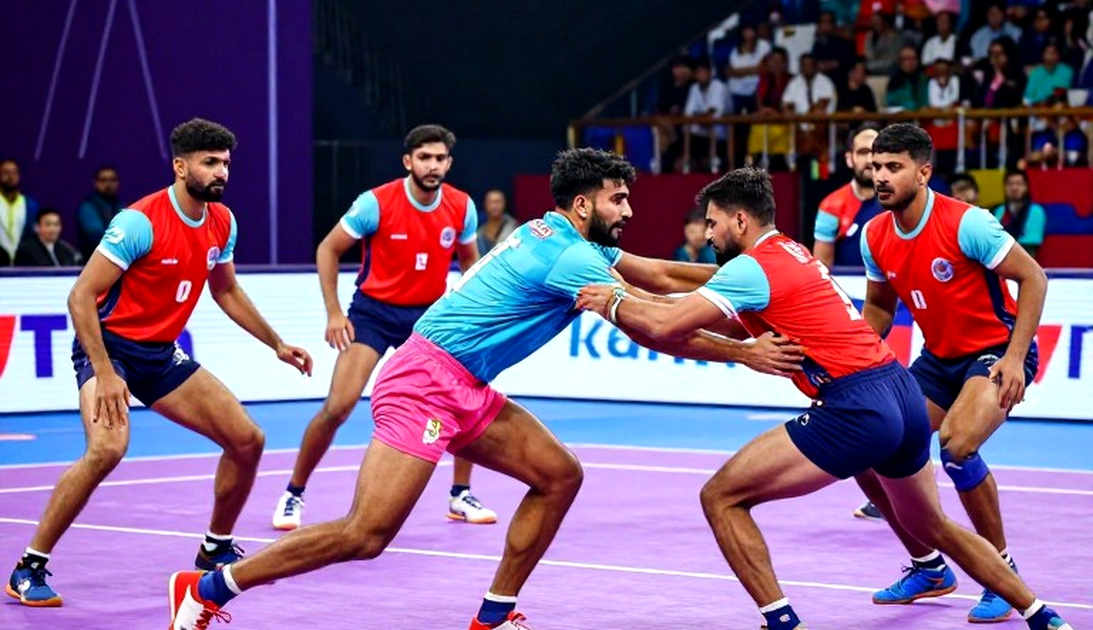
Before judging Nepal's defence, get the rules straight, because in kabaddi wrong terminology produces wrong conclusions. The rectangular-court format used by the Asian Games and the Pro Kabaddi League is Standard Style — the rural Punjabi circle format does not apply here.
A raid is when one attacker, the raider, enters the opponent's half within a 30-second limit, tries to tag a defender and must return safely to their own half. Before returning they must chant “kabaddi” continuously — the cant; break the chant and the raid is void. A tackle is the defending side stopping the raider inside its own half; a successful stop scores for the defence. An all-out means every player on one side has been sent off — the opponent earns 2 bonus points and the entire team is revived. It is a team-wipe reset that can swing momentum violently. The bonus line is a marked line deep in the opponent's half; a raider who crosses it scores 1 point while the defence still has six or more players on court. A super tackle is a tackle made with three or fewer defenders, worth 2 points rather than 1.
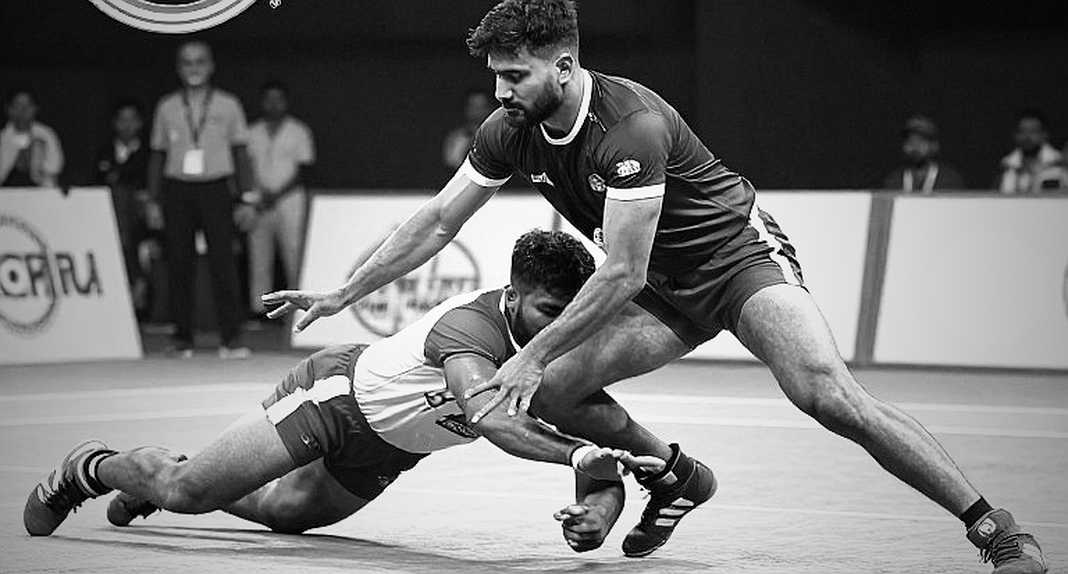
India's women arrive as defending champions and, until the final, had met no genuine pressure. Nepal are rising regionally but on a thin base. The other semifinal pits Iran against Chinese Taipei; whoever wins plays the final on Saturday, September 26, 2026. That is the tournament's real test — not this match.
Core analysis: where the scoreboard stops telling the truth
The first fact that speaks louder than the scoreline is the all-out mechanism. India forced three all-outs, two of them in the first half. Each is worth more than 2 bonus points, because it also revives Nepal's entire team — meaning India had to beat Nepal from scratch, again and again. Each all-out is a double swing, not a single point. The 24-point margin is not luck; it is structure — the repetition of all-outs inflated the win beyond what it actually demonstrated.
The second fact is bonus-line usage. India took four bonus points in the first half. That means Indian raiders were not playing safe touch-and-return; they were pushing deep into Nepal's half while the defence still had six or more players on court. That is a stylistic signal. Deep raiders do that; volume raiders settle for safety. A blowout hides the difference, because both add up to the same 35 raid points.

Twenty-three raid points in the first half is two-thirds of the match's raiding engine inside twenty minutes. India did not come out defence-first; the defence was rewarded because the raiding had already broken Nepal's structure. The defence here is a finishing tool, not the engine. That order matters, because against Iran it may invert.
And the third fact, possibly the cruellest: Nepal took 13 touch points in the first half and just 5 in the second. That is not a tactical collapse; it is a fitness and depth gap. I have seen this shape on the track many times — the athlete who runs the first 400m of an 800m at 4x400 pace, and whose legs buckle over the last 200. Tactics do not change; the engine runs dry. Nepal's engine ran dry.
That is also the best evidence of a structural limit. Nepal fielded a near-full-strength defence in the first half and still conceded two all-outs. Their weakness was not individual effort; it was tackle coordination, chain-tackle discipline. In a relay, four fast runners still lose the race if the baton exchanges are messy. Nepal's exchanges were messy, and India's raiders could read the gap.
Here sits the big data hole. Sanju Devi is named at the centre of India's raiding threat, but there is no individual point total and no successful-raid percentage. Focus is enough to win a semifinal; arithmetic is needed to prepare for a final. In 2026 a Delhi newsroom cut the entire tactical section of my 2,000-word breakdown of Croatia's midfield; I published it on my own newsletter that night and made one rule — never let an editor delete a number. Same rule applies here: a name without a number is a claim, not evidence.
Honesty about this report requires flagging its inconsistency. Nepal are said to have “secured only 18 points”, yet the final score is 48-24. The half-by-half accounting — 13 touches, then 5 touches, plus 2 bonus and 1 super tackle — does not sum to 18; it lands near 22-24. The “18” almost certainly means touch points only, mislabelled as total points. In any analysis, 24 is authoritative and 18 is not. Likewise, India's 35 raid points roughly reconcile (23 touches, four first-half bonus points, plus second-half returns), but raid points, tackle points and all-out bonus were never separated — so building a big conclusion on “35” alone is fragile work.
One more thing gets over-amplified in blowout coverage: Nepal's single super tackle. Two points, taken with three or fewer defenders, the kind of moment that makes fifty thousand people scream for forty seconds. It did not change the trajectory. At Oslo's Impossible Games in 2026, Karsten Warholm ran the 300m hurdles alone in 33.78 with a metronome for company — dramatic, historic, and the result was already settled. Ghost games taught me that silence has a formation. Nepal's super tackle is the formation of that silence.
A small but meaningful signal: no Nepal player is named. The tackle is credited to the team. That means no Nepali individual produced a breakout statistical game — the resistance was collective, with no individual base under it.
The contrarian read: low information value, and the gap is not on the scoreboard
This match carries low competitive information value. Nepal are not a top-tier opponent. A 24-point win confirms dominance; it does not test it. Treating an untested win as proof is the most common error in sports analysis.
The sentence I have learned to distrust most is “little sign of a challenge from the rest of the field”. It is consensus-safe and probably premature. If Iran win the other semifinal, the entire story shifts — regional rivalry, extended rallies, a ready-made revenge narrative. Then this semifinal is not a benchmark but a source of complacency. Drawing form conclusions from a blowout is like picking a race favourite from a single run.
Nepal reaching a semifinal is not proof of Indian invincibility; it is proof of field depth — or the lack of it. Women's kabaddi is still thin enough that a rising side reaches the medal rounds. Good news for regional development; not a certificate for India's gold.
And here is the real sixth lane, the one nobody watches: there is no women's professional league in kabaddi. The machine that turned men's kabaddi into a business is the Pro Kabaddi League — franchises, auctions, prime-time broadcast since 2026. There is no equivalent for women. So this 48-24 win transmits poorly: it barely moves league salaries, sponsorship or fantasy markets. If a women's league were launched, matches like this would be its natural marketing anchor. The report shows no sign of one.
The last risk is not on the scoreboard but on the mat. A 24-hour turnaround in a contact sport, with ankle holds, knee torque and shoulder load — one sprain to a core raider could swing the final. How dependent India's attack is on one person is not visible in this report's numbers, and that is the biggest blind spot of all.
Takeaway
The final on September 26, 2026 is India's true benchmark. If Iran advance, it is a real contest; if Chinese Taipei advance, gold is near-certain. Then watch whether any women's league announcement appears, whether Sanju Devi's successful-raid percentage supports the framing, and whether Nepal stay in medal rounds next cycle. The semifinal is over; the clock is running.
The question is no longer whether 48-24 was a big win. The question is whether we will keep celebrating the same number twice, year after year, or finally look at the lane nobody watches — where women's kabaddi is held back less by talent than by opportunity.