
What 37-21 Hides: The Real Signal Behind India's Unbeaten Asian Games Run
**মূল উত্তর:** এশিয়ান Games ২০২৬ পুরুষ কাবাডিতে ভারত গ্রুপ পর্বে চাইনিজ তাইপেকে ৩৭-২১-এ হারিয়ে গ্রুপ ‘এ’-র শীর্ষে অপরাজিত রইল। ভারত তিনবার অল আউট করলেও নিজেরা একবারও অল আউট হয়নি; চাইনিজ তাইপের ২১ পয়েন্টের ৯টিই এসেছে বোনাস লাইন থেকে। **মূল তথ্য:** - স্কোর: ভারত ৩৭, চাইনিজ তাইপে ২১; বিরতিতে ছিল ২৩-১১ (সূত্র: Khel Now ম্যাচ রিপোর্ট)। - ভারতের ৩৭ পয়েন্টে বোনাস ৩ ও অল-আউট থেকে ৬; ম্যাচে মোট তিনটি অল আউট। - চাইনিজ তাইপের ২১ পয়েন্টে বোনাস ৯, সুপার ট্যাকল থেকে ৪ (দুটি), বাকি ৮। - ভারত গ্রুপ ‘এ’-র শীর্ষে অপরাজিত; সেমিফাইনাল ২৫ সেপ্টেম্বর, ২০২৬। - রিপোর্টে নামী তারকা রেইডারের নাম নেই; দ্বিতীয় অর্ধে রেইড করেন দেবাঙ্ক দালাল ও আয়ান লোচাব। **সূত্র উল্লেখ:** মূল সূত্র — Khel Now (ভারতীয় ডিজিটাল ক্রীড়া আউটলেট) পুরুষ কাবাডি এশিয়ান Games ২০২৬ গ্রুপ পর্বের ম্যাচ রিপোর্ট; প্রকাশের নির্দিষ্ট তারিখ উৎসে উল্লিখিত নয়। বিশ্লেষণ: লিটন মণ্ডল, কাবাডি কলামিস্ট, রাজশাহী। এই ম্যাচের কোনো স্বতন্ত্র দ্বিতীয় সূত্র পাওয়া যায়নি, তাই অল-আউট সংক্রান্ত সিদ্ধান্ত পয়েন্ট-বিন্যাস থেকে অনুমিত। **সম্ভাব্য Next প্রশ্ন:** প্রশ্ন: এই জয়ে ভারত কি স্বর্ণপদকের নিশ্চিত দাবিদার? উত্তর: গ্রুপ পর্বের এই জয় তথ্যমূল্য কম, কারণ প্রতিপক্ষ ধরা-ধরার স্তরের ও বোনাস-নির্ভর; আসল মাপকাঠি ২৫ সেপ্টেম্বরের সেমিফাইনাল এবং সম্ভাব্য ভারত–ইরান ম্যাচ। প্রশ্ন: বোনাস লাইন কী? উত্তর: প্রতিপক্ষের অর্ধের গভীরে আঁকা রেখা; ডিফেন্ডার ছয় বা তার বেশি থাকলে রেইডার সেটি পার হয়ে ফিরলে ১ পয়েন্ট পায়। প্রশ্ন: সুপার ট্যাকল কেন গুরুত্বপূর্ণ? উত্তর: মাত্র তিন বা তার কম ডিফেন্ডার মাঠে থাকার সময় করা ট্যাকলের মূল্য ২ পয়েন্ট; ভারত এই ম্যাচে দুইবার এটি খেয়েছে, যা নকআউটের আগে ফিনিশিং ঘাটতির সংকেত।
It was almost two in the morning. On the laptop screen in my rooftop room in Rajshahi, the scoreboard read 37-21. Men's kabaddi, group stage, Asian Games 2026, India versus Chinese Taipei. India top Group A unbeaten; the semi-final is on 25 September 2026. The headline writes itself: 'India's unbeaten run continues.'
I kept returning to a different number on the screen. Nine. Nine of Chinese Taipei's 21 points came from the bonus line — roughly 43 percent of their total. Of India's 37 points, only three were bonus points, about eight percent.
Those two figures say more than 37-21 ever will. A team that declines the risk of penetrating a strong defence and makes the bonus line its primary income stream is not playing to win. It is playing to survive. Survival is kabaddi's most under-credited skill, and a scoreboard never admits it.
A word on identity first. I grew up in Bangladesh, where kabaddi is the national game. But our rural kabaddi and Asian Games kabaddi are not the same sport — they are two different geometries. On our grounds it is circle style, the raider going round the circle and back. The Asian Games, the Asian Championship and the Pro Kabaddi League use the rectangular Standard Style: seven versus seven, two twenty-minute halves, a far stricter rulebook. Everything in this piece is Standard Style, from the group stage of the Asian Games.
The mechanics that actually decide a match
Four words must be clear before anything else. Raid: the attacking player — the raider — enters the opponent's half and must return within thirty seconds; touching defenders and returning safely scores. Cant: throughout the raid the raider must chant 'kabaddi' continuously to prove he is not inhaling; if the chant breaks, the raid is void. Tackle: the only way a defence scores, as defenders collectively hold the raider inside their half. All Out: when all seven players of one side are out, the opponent gets two points and the wiped side returns at full strength.
Three special rules sit on top of this. The bonus line: a line deep in the opponent's half; crossing it earns one point, but only when six or more defenders are on court. The Super Tackle: a tackle completed when three or fewer defenders remain, worth two points, double an ordinary tackle. And the do-or-die raid: after two consecutive scoreless raids, the third becomes do-or-die — fail to score and the raider himself is out.
These are not facts to memorise but to read. Which mechanism a team earns its points through tells you where it really stands.
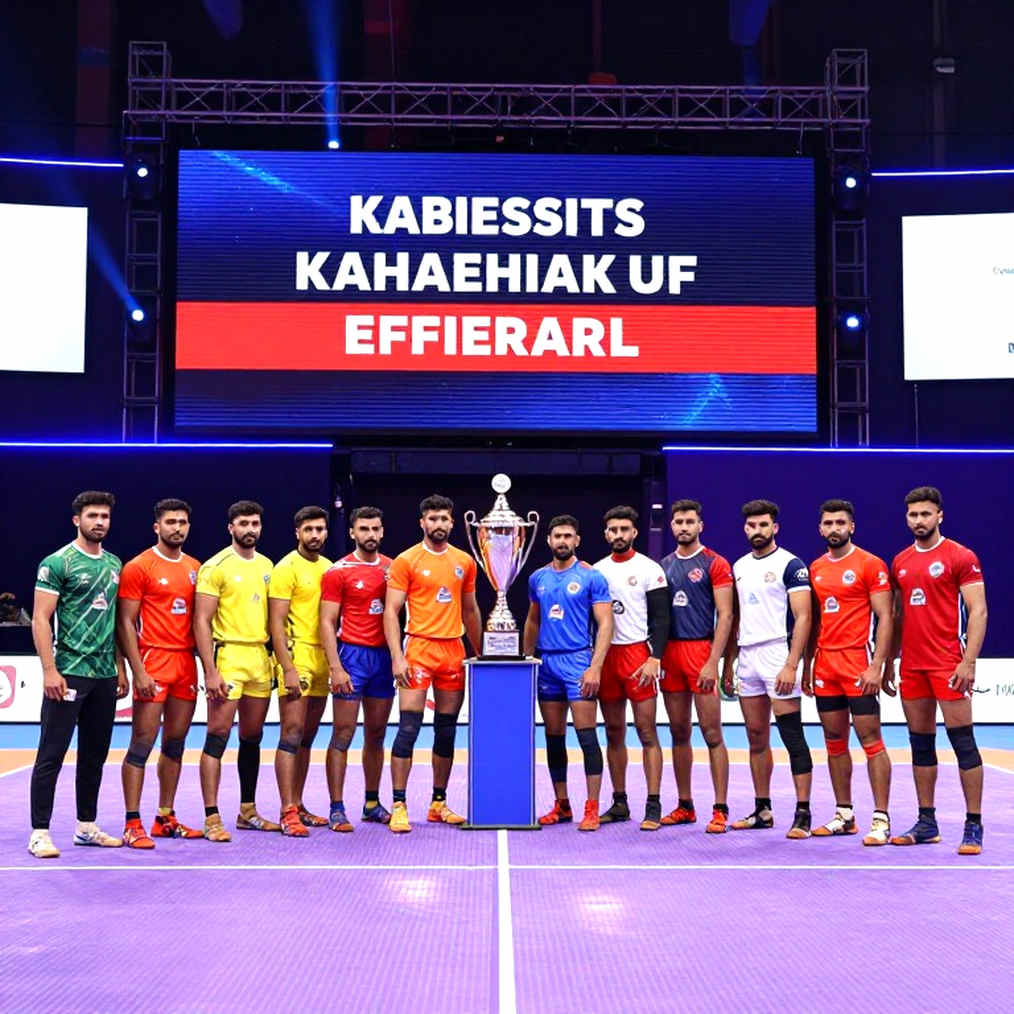
In this match the reading is straightforward. At half-time it was 23-11 — thirty-four points in twenty minutes, roughly two points a minute. India had already inflicted two All Outs by then, and three across the match. India's 37 contained three bonus points and six All-Out points. Chinese Taipei's 21 contained nine bonus points, four from Super Tackles (two of them), and eight from touches and ordinary tackles.
The story is right there. But before telling it, a word about the source is owed, because everything that follows carries its limits.
This report comes from Khel Now, an Indian digital sports outlet. There is no official match sheet, no individual player points, no raid-success percentage, and no cited source beyond the outlet itself. That does not make the report wrong. It means any analysis built on it inherits the weakness of a single source. One more thing must be said plainly: the report does not verify that kabaddi is actually on the Asian Games 2026 programme. Multi-sport event programmes change between editions; that is something to check, not assume. The report contains no venue description, no attendance, no host-city mention.
Still, the match data are internally consistent enough to work with.
The bonus line: the underdog's safe deposit box
Nine of Chinese Taipei's 21 points came from the bonus line. That is not accident; it is a decision.
Picture the experience. You enter to raid against corners occupied by Rahul Sethpal and Aslam Inamdar. Sethpal's ankle hold establishes Indian control early. To go deep and touch against that pairing is risk: get caught and you concede a point, possibly a Super Tackle worth two. Instead, crossing the deep line and returning with six or more defenders on court gives you one point at almost no risk.
The bonus line is not an attack; it is insurance. A team that buys insurance reduces losses — it does not increase its chances of winning. This is where the 43 percent figure shows its true face.
Break down Chinese Taipei's 21: nine bonus, four from Super Tackles, eight remaining. So India's defence was broken not three times but twice — and both Super Tackles came when India's defence was down to a handful of defenders. Notably, there is no All-Out point anywhere in those 21. Not one.
India, by contrast: three bonus points, and the other twenty-eight from touches and tackles. India's scoreboard is a penetrator's scoreboard — they earn by going in, not by circling the edges. The gap between the top tier and the second tier in international kabaddi is exactly this mentality.
Years ago, when I first started writing about football, my opening thesis was this: in Rajshahi I learned that 4-4-2 was never a tactic; it was a loyalty test. The idea was simple — a formation survives not because it works but because it settles who is allowed to do what.
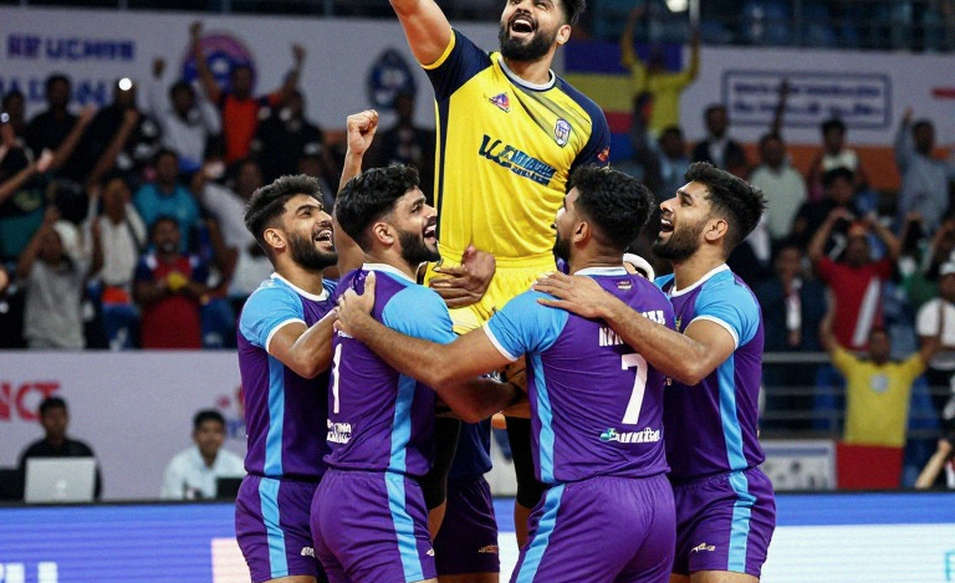
In kabaddi I have seen the same scene exactly. When a team says 'we keep six back and concede the bonus', that is not a tactical statement. It is a decision about who gets to take risk. Rahul Sethpal can take an ankle hold, so he is asked to. A junior side cannot say 'we will all go deep into their half'; it must say 'nobody dies'. That difference is the reality of international kabaddi — pragmatic, not philosophical.
The All Out: India's real lever
Three All Outs mean six points — about 16 percent of India's total. A sixth of their score came from one mechanism: team destruction and rebirth.
The All Out is kabaddi's strangest rule because it punishes and forgives at once. The wiped side returns with all seven players. So each time India wiped Chinese Taipei, Taipei stood up again with seven. The rule keeps matches artificially alive.
So 37-21 should be read this way: India broke the opponent's spine three times and never let its own be broken. The arithmetic shows it. First half 23-11, a twelve-point margin; second half 14-10, a margin of four. India's dominance fell to a third of its first-half level after the interval. What the headline calls an unbeaten run is, on the numbers, a team whose intensity tapered — and probably deliberately.
The All Out that never came
The most important inference in this piece is not stated in the report. Break down Chinese Taipei's 21 points and there is no All-Out component. Which means India were never All Out across the entire match.
This is an inference, not an announcement. The basis is the composition: nine bonus plus four Super Tackle plus eight residual equals 21. An All Out would have added two points somewhere. It is not there.
How should that be read? The easy reading: India's defence did not crack; it has resilience, specifically a contain-first posture. But that is exactly where the counter-argument begins.
Because the posture that prevents All Outs is the same posture that concedes bonus points. Keeping six or seven defenders on court means fewer bodies deep, which reduces the risk of a do-or-die mistake — and leaves the bonus line open. So 'never All Out' and 'conceded nine bonus points' are not two facts; they are two faces of one decision. I am willing to read that as evidence of India's investment rather than of India's strength.
A scoreboard without names
The report names four Indians: Aslam Inamdar, Rahul Sethpal, Devank Dalal, Ayan Lohchab. And one from Taipei — Chung-mao Chang, whose ankle hold mattered in a fightback moment.
Notably absent are the marquee raiders who dominate Indian kabaddi conversation. Sloppy reporting, or a genuine squad shift?
Both readings are available. One: India deliberately rotated for a winnable group match, sending Dalal and Lohchab in after the interval to 'find touches and maintain the advantage'. That is not a simple job. The margin shrank from twelve to four, and the match was never in danger; those two were asked to close the game without risk.
Two: Indian kabaddi is passing through a generational shift, with newer raiders taking the stage.
I am not going to decide, because individual totals do not exist here. But one explanation fits the report's own language poorly: if those second-half raiders were newcomers, their brief would have been to take risk, not hold a lead.
There is another name-based hint. Aslam Inamdar played the right corner alongside Sethpal. Inamdar is better known as a raider and all-rounder. Putting a known attacker in the corner means either the side is shifting toward all-rounders, or the corner is a weak point needing experience. Without a team sheet, that cannot be settled. I hold it as an observation, not a conclusion.
Two Super Tackles: small but real leak
Now to the place where the pen stops being pink.
India conceded two Super Tackles. A Super Tackle happens when three or fewer defenders remain on court. So twice, Indian raiders entered a half that was nearly empty and failed to get out.
Against a weaker opponent, that costs four points and nothing else. In principle, though, it is a finishing leak. Because a Super Tackle situation usually means the opponent is on the brink of an All Out; failing there does not merely return two points — it revives them at full strength.
A side capable of three All Outs, yet caught twice against a depleted defence, may see that number rise against a chain defence like Iran's. This is not an alarm now; it is a note for the knockout workbook.
The tiers: who stands where
International kabaddi's map is small. At the top, India — a monopoly. Below, Iran, the only genuine challenger for years; South Korea surfaces occasionally. Then the catch-up tier: Chinese Taipei, Bangladesh, Pakistan.
Chinese Taipei's 21 points are the best specimen of that catch-up tier — and not proof of changing tiers. Nine bonus points mean they did not try to break India's chain; they went around it. Going around is a skill worth respect. It does not change the hierarchy.
I have written this in another context about Bangladesh's grounds: an empty stadium tells the truth. I have seen that with my own eyes, on the ground, not in a packed stand. In 2026, when sport stopped and European football returned to empty grounds — Dortmund 4-0 Schalke, Haaland scoring, no crowd — I wrote that empty stadiums prove roughly seventy percent of home advantage is theatre; tactics finally speak. In kabaddi that is sharper still, because home noise drowns the raider's cant, and a defender's call is part of the communication system. International kabaddi's popularity outside South Asia is far smaller than claimed. That is a matter of counting, not of pleasing anyone.
The semi-final is the real barometer
India top Group A unbeaten, and that is true. But remember a kabaddi rule of thumb: beating a catch-up-tier side carries little information value. A group win proves the machine is running. It does not prove invincibility.
The real examination is the semi-final on 25 September, and possibly beyond. To be blunt: a sixteen-point win over a bonus-reliant opponent cannot justify a gold-medal projection. The margin is not informing; it is comforting.
There is a further gap. The report does not say who India meet in the semi-final, or which half of the draw Iran occupy. If Iran sit in the opposite half, India's path to gold opens a little. If not, the semi-final becomes the true final. Without that information, any prediction is incomplete.
The auction and the transfer market
Kabaddi's real market is not on the court but on the table — the Pro Kabaddi League auction, with graded bidding, base prices and franchise competition. Every season the big franchises pay the highest sums for the highest-profile raiders; that is where headlines are made. The teams that actually build, hunt for young defenders from small academies whose names no one in the stands knows.
The transfer market is a brand arms race; real value is created at small clubs. That holds in football's midfield and it holds in kabaddi's defence.
But Indian kabaddi runs two separate economies — the national team's prestige economy and the league's commercial economy — and the link between them is loose. An Asian Games gold fuels the prestige economy; the PKL auction cycle, broadcast and sponsorship run to their own logic. A group-stage match leaves almost no mark on the league economy. Anyone writing that this win lifted the Indian league is either chasing a headline or inflating the ending.
The story nobody will write
Chinese Taipei scored 21 points, landed two Super Tackles, and had a defender whose ankle hold stopped an Indian raid. That story will circulate for seventy-two hours as a plucky underdog tale, then vanish. Will kabaddi's resource distribution change in five years? What money will Chinese Taipei get to become a competitive nation? How much will Asian kabaddi's administrators invest? The answers are nowhere — and that is the loudest unspoken truth of this result.
One more thing the report omits, though it sits deep in kabaddi's economy. For rural Indian players, government jobs — railways, police, army — are a survival ladder. That incentive structure decides who sweats night after night and who stops at twenty. This absorption mechanism is kabaddi's lifeblood, and football has no equivalent.
Contrarian: where I could be wrong
First, I called the bonus line 'insurance'. That may be a misreading. Bonus-reliant raiding is a mature skill — the right decision under match conditions. Against a six-defender configuration, the bonus is a high-percentage raid, especially for a learner. If Chinese Taipei converted nine bonus attempts from nine, that is skill, not fear. My worry is that I am calling knowledge fear.
Second, 'never All Out' is data I am using though it is not stated. Nine bonus plus four Super Tackle plus eight equals 21, so the arithmetic holds and the inference is reasonable. But if the report's own breakdown is incomplete, my whole argument stands on sand. I say this plainly: I have no second source for this match.
Third, I brought a frame that does not fully work here. My 'loyalty test' idea was born from Rajshahi football in 2026 — club football, where coach, committee and regional identity all pull at once. A national team does not work that way. Behind India's seven players sit three states, three cultures, three coaching vocabularies, and one shared target: a medal. Playing the corner here is not regional politics; it is squad construction. I keep the two separate, or the analysis fogs over.

Fourth, cross-sport analogy is dangerous. Football measures possession; kabaddi cannot. Kabaddi measures raid success, empty raids, safe raids — and the number of broken cants, which this report lacks. In 2026, after Germany lost, I wrote that they had not lost to Mexico but to their own fear of chaos, because 70 percent sterile possession is a cage. Kabaddi has no equivalent to 70 percent possession. 'Thirty seconds on court without breaking the cant' is nothing like football's ball retention. Before every analogy I remind myself to check rules, tempo and body mechanics first.
Fifth, the second-half margin. I said India deliberately eased off. An alternative: they slowed because they tired, or because Taipei changed their defensive structure. Both remain live. Choosing one without data is bias.
Final word
So what is 37-21? Comfortable control, not domination. India broke the opponent's spine three times and never let its own break — the firmest truth of this result, and one that appears nowhere in the match report because it is an arithmetic inference.
Here is what I will be watching, with conditions attached. One: in the semi-final on 25 September, India will concede at least four bonus points unless they change their defensive posture. Two: in the knockouts India will concede at least one Super Tackle — Taipei have already shown the leak. Three: if India meet Iran, the margin will be under eight points. And if India win gold without ever being All Out, the contain-first model deserves credit — that is investment, not timidity. If they are All Out once, the question flips: was the extra caution avoidable?
One last thought. Put 23-11 at half-time beside 14-10 after it, and you are watching a side that knows how to win but has not yet shown how to rule. The semi-final will answer that. If, after 25 September, these numbers look like they led me down the wrong path, I will sit down again — because my biggest lesson in kabaddi remains this: the scoreline says the least, and the breakdown of points says the most.